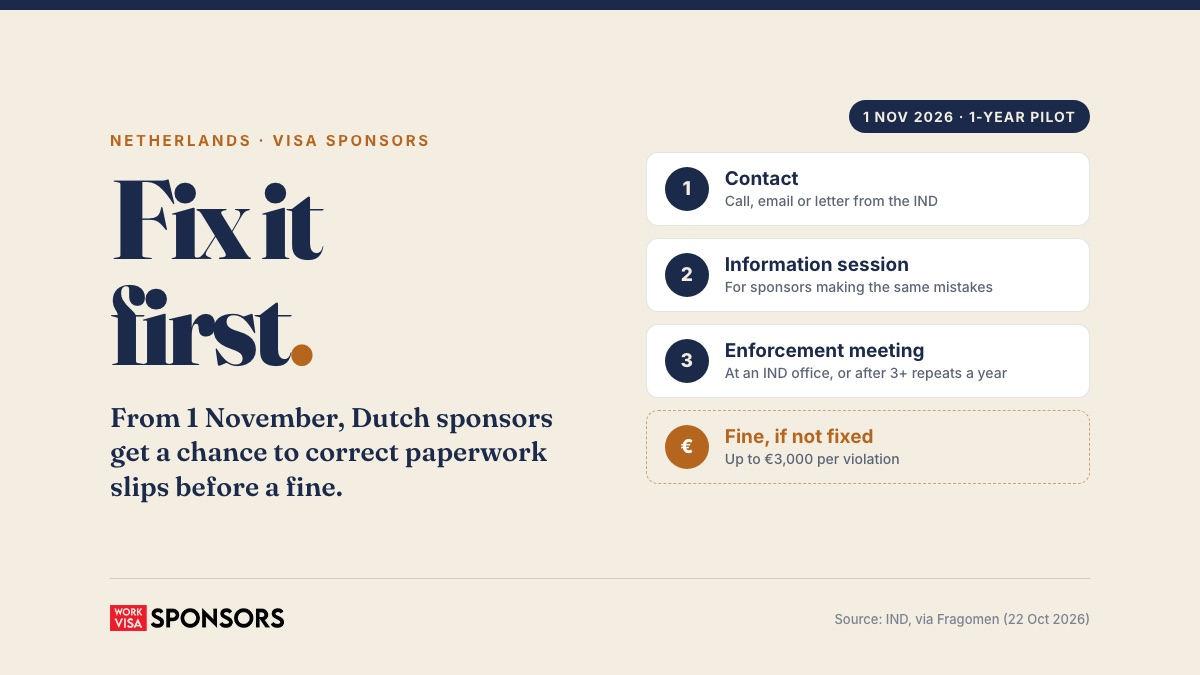
From 1 November 2026, the Netherlands will give employers who sponsor foreign workers a chance to fix certain paperwork mistakes before they are fined. The Dutch Immigration and Naturalisation Service (IND) will first contact the employer, invite it to an information session, or call it to a meeting. A fine comes later, and only if the employer does not put things right.
The change is aimed at employers, but it matters to you too. In the Netherlands, your work permit is closely tied to your sponsor, and your sponsor's record-keeping can affect your stay. Here is what is changing, what is not, and how it compares with sponsorship in the UK.
The key points
- Start date: 1 November 2026, as a one-year pilot. The IND will then decide whether to keep it, change it or drop it.
- Who it covers: recognised sponsors (erkend referenten), the employers and universities the IND has approved to bring in workers and students from outside the EU.
- What it covers: only two duties. Keeping records on sponsored people, and telling the IND about certain changes.
- What it does not cover: fraud, abuse and breaches of the employer's duty of care. Those are still handled with fines and other sanctions straight away.
What changes on 1 November
When the IND finds one of the covered mistakes, it can now respond in one of three ways before reaching for a fine:
- Direct contact. A phone call, email or letter to the employer about the problem.
- Information sessions. Group sessions for sponsors that make the same kind of mistake.
- A formal enforcement meeting. The employer is invited to an IND office to explain and fix the issue.
The aim is better compliance, not lighter rules. Employers still have every duty they had before.
Which mistakes are covered
According to immigration law firm Fragomen's advisory of 22 October 2026, the softer first response applies when a sponsor fails to tell the IND about:
- a change in where it keeps its records on sponsored people;
- a worker moving to another company in the same group that is also a recognised sponsor;
- a work contract or study programme that ends on the same day as the residence permit;
- a residence permit that has expired, or will expire within four weeks;
- a worker who has already been given a residence permit for a different purpose.
If the same mistake happens more than twice in a year, or if the mistake is not on this list, the employer goes straight to a formal enforcement meeting.
What stays the same
- Fines still exist. If an employer shows no willingness to fix the problem, the IND applies its normal fine policy. That means up to €3,000 per violation for a company. A repeat breach of the same duty within two years raises the fine by 50%.
- Serious breaches are not covered. Fraud, abuse and breaking the duty of care toward workers are still dealt with through fines, suspension or withdrawal of sponsor status.
- Suspension and withdrawal remain. The IND can suspend a sponsor's recognition for three months at a time while it investigates, or withdraw it.
Why this matters if you work, or want to work, in the Netherlands
Most of the listed mistakes are about you: when your contract ends, when your permit expires, or when you move within a company group. Your sponsor reports those changes for you. If it reports them late or not at all, your file at the IND can be wrong.
The pilot is also part of a wider tightening. Over the past year the IND has stepped up inspections of sponsors. Since 1 January 2026, employers of highly skilled migrants and EU Blue Card holders must keep proof that each salary actually reached the worker's bank account, not just a payslip. Sponsors that fall short risk losing their recognition, and that makes it harder for them to hire from abroad.
A few practical steps protect you:
- Check the employer is a recognised sponsor before you accept an offer. The IND publishes a public register of recognised sponsors.
- Know your permit end date and tell HR early if your contract or role is changing.
- Make sure your salary is paid into your own bank account and keep your payslips and bank statements.
- Know the salary you need. In 2026 the highly skilled migrant threshold is €5,942 a month for people aged 30 and over, €4,357 under 30, and €3,122 for eligible recent graduates. These amounts exclude the 8% holiday allowance.
How the UK compares
The UK runs a similar system. Employers need a sponsor licence from the Home Office to hire most workers from abroad on the Skilled Worker visa, and they have duties to keep records and report changes. The approach to mistakes is stricter, though:
- Tighter deadlines. UK sponsors must report most changes about a sponsored worker within 10 working days, through the Home Office's online sponsor system.
- Higher penalties. Employing someone without the right to work can bring a civil penalty of up to £45,000 per worker, rising to £60,000 for repeat breaches.
- No pilot of "fix it first". The Home Office can downgrade, suspend or revoke a licence after a compliance visit.
- Revocation hits workers fast. If a licence is revoked, sponsored workers usually have their permission cut to 60 days to find a new sponsor, switch visa, or leave.
The lesson is the same in both countries. Your sponsor's compliance is part of your immigration security, so it is worth choosing a well-established, licensed employer.
Find a sponsor you can trust
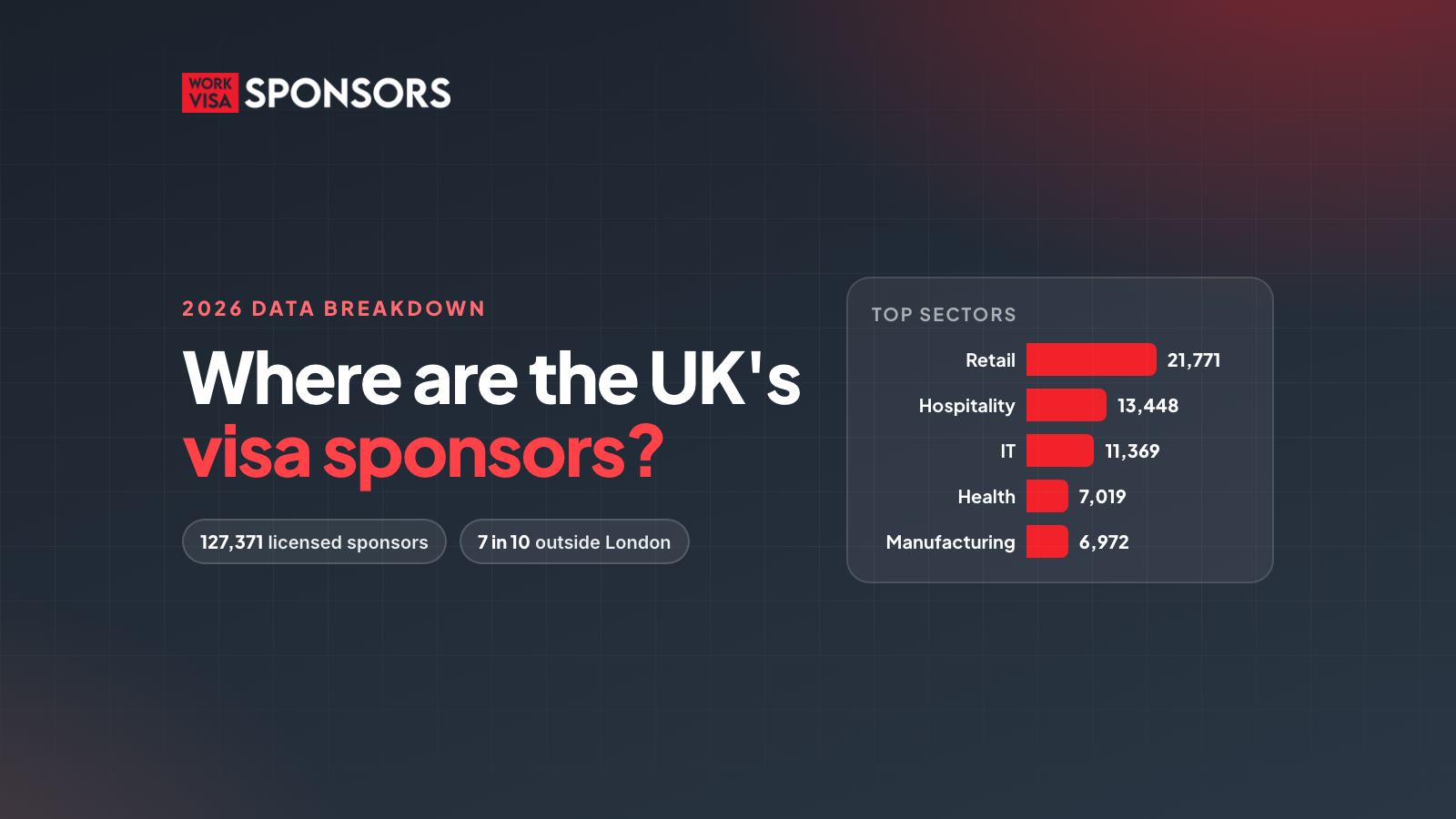
- Apply only to licensed sponsors. Over 127,000 employers hold a UK sponsor licence. Search them by name, sector or city on our UK sponsor list.
- Browse jobs from sponsors. See current openings on our jobs page.
- Spot sponsors while you search. Our free browser extension flags licensed UK sponsors on Indeed, LinkedIn, Glassdoor and Totaljobs, and can tailor your CV to a sponsored job in one click.
About this article: details of the Dutch pilot come from immigration law firm Fragomen's advisory of 22 October 2026 and Nairametrics' report of 24 October 2026. One earlier adviser note gave 1 October as the start date, so check the IND's website for the official announcement. Fine amounts are from the IND's administrative fines page. Salary thresholds are the IND's 2026 figures as reported by Deloitte. UK rules are from GOV.UK and can change. This article is general information, not legal advice.
EO
Eric O.
Work Visa Sponsors editorial team · Guides on sponsorship, visas and international job search